
The University Extension Program Office under the R&E program undertakes innovative and relevant extension programs and services for enhanced technology dissemination and utilization efforts in cooperation with the other units and colleges of the University and other agencies. The Program provides technology services, information services, local governance development, resource linkage/networking, nutrition and livelihood, consultancy, and village-level infrastructure project development.
The extension activities of the University started when it became a part of the instruction program of the College of Education in the mid-1950s. Two instructors of the college performed outreach or extension activities. In the 1960s, the college instructors initiated the demonstration projects in Muñoz with the help of Australian and two Japanese Peace Corps volunteers. The barangay/village served as a learning field laboratory for students, especially those rendering field practice or on-the-job training as requirements for the Extension Education curriculum.
In January 1964, the Extension Office and Services was established under the Graduate Education and Research. It was also when President Diosdado Macapagal signed House Bill No. 9354 and Republic Act 4067, converting the Central Luzon Agricultural College (CLAC) into Central Luzon State University (CLSU) on January 18, 1964. The Extension Office and Services was tasked to coordinate the various extension services and activities of the colleges and units of the University. Some of the extension programs and projects included the establishment of rice demonstration farms, the introduction of micro-farm mechanization, the establishment of the Bureau of Animal Industry (BAI) artificial insemination center in the University, the establishment of a rice seed bank in Central Luzon, conduct of rice production workshop for teachers, and establishment of partnership and collaboration with government agencies providing extension services to farmers and their households.
On July 9, 2020, the proposed Revised University Code subject to full and strict compliance with all existing government rules and regulations, as well as the subsumption of the Training Office under the Extension Office and the latter remaining as University Extension Center (UEC) was approved under Resolution No. 10-2020 during the CLSU Board of Regents' 221st Regular Meeting (2020 1st Quarter Meeting) via zoom platform., thus merging the Extension Office and Training Office into one as "University Extension Center". The training became one of the modalities/divisions of the center in providing information and technology services.
The name University Extension Center was then renamed to University Extension Program Office (UEPO) by Resolution No. 7-2023 during the Board of Regents 232nd Regular Meeting (2022 4th Quarter Meeting) held on January 16, 2023 via Zoom platform.
The University Extension Program Office is a primary arm in disseminating innovative technologies and promoting people empowerment towards inclusive growth and sustainable development.
The University Extension Program Office shall pursue integrated, multi-disciplinary, and participatory programs and services to facilitate the diffusion and adoption of appropriate agricultural and social technologies for effective local governance, people empowerment, social-economic upliftment, and sustainable development.
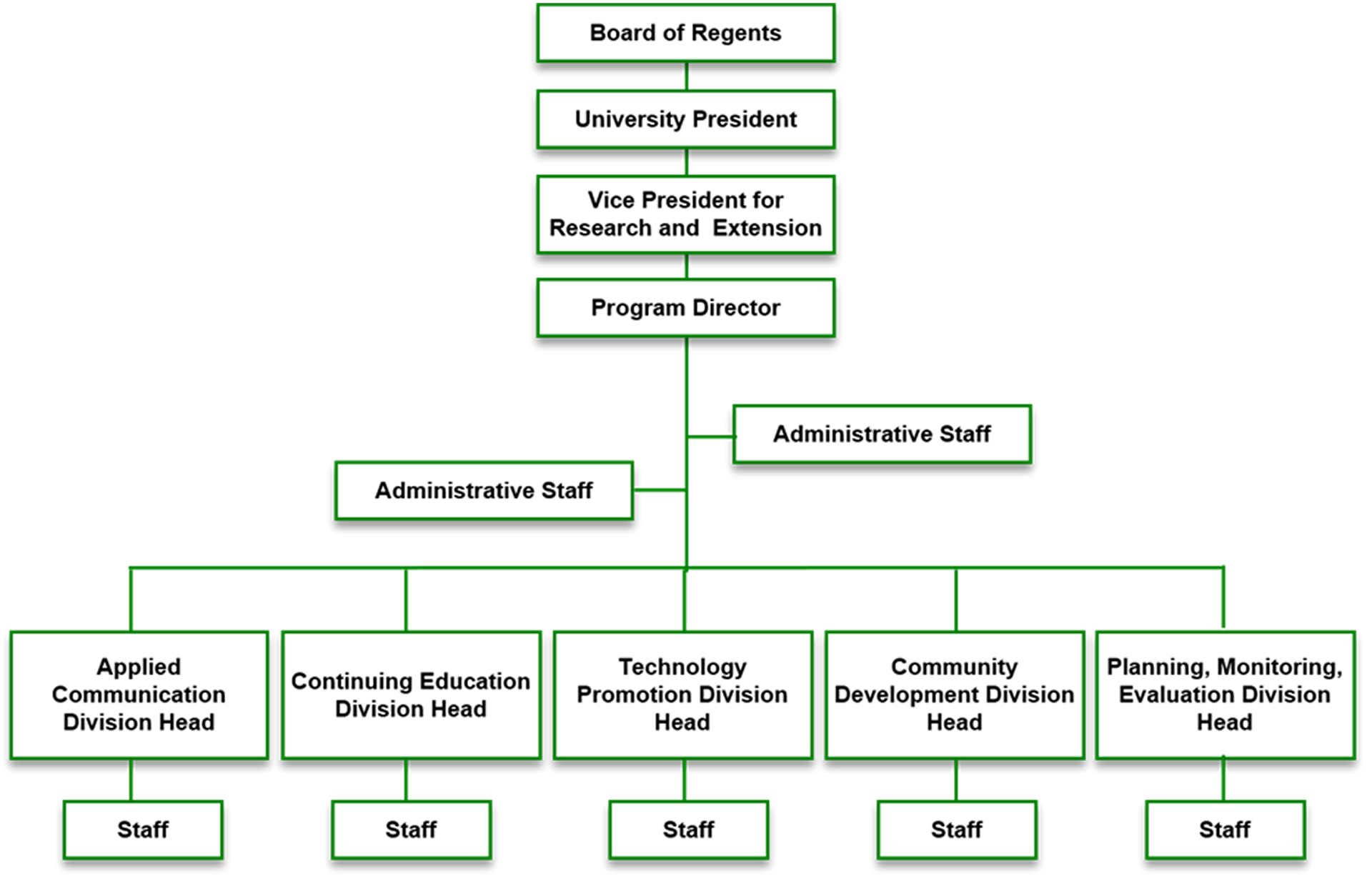
The University Extension Program Office (UEPO) is under the R&E program, headed by the Vice President for Research and Extension (Figure 97). The Program Director is designated by the University President for one (1) year without prejudice to re-designation, subject to the confirmation of the Board of Regents. The Director must be a doctoral degree holder in Philosophy specializing in extension, rural development, development communication, community development, and allied disciplines with an academic rank of at least Associate Professor I. They shall have at least three years of extension management experience and three years of administrative experience.
The Program Extension Coordinator of UEPO, who also serves as the R&E Program Extension Coordinator, works hand in hand with the Academic Program Extension Coordinator in consolidating all extension projects and activities of their respective programs and collaborating/harmonizing for a more comprehensive and more impact extension projects for the University's intended clienteles. Each unit/department under the R&E and Academic Affairs programs has a designated extension coordinator. All coordinators are appointed for one (1) year.
The UEC comprises five (5) distinct and interrelated program components that contribute to and work together towards attaining organizational goals, namely Applied Communication, Continuing Education, Technology Promotion, Community Development, and Planning, Monitoring, and Evaluation. Each component is managed by division heads whose designation is renewable yearly. The functions of the said components are detailed on the next page.
Staff performing technical and administrative work are assigned in the various divisions to the frontline, carrying out the center's objectives, programs, and projects. However, administrative staff are directly under the Office of the Director.
The field operation arm assesses clients' technology and project needs, establishes farm demos and techno livelihood projects to showcase recommended technologies and management practices, facilitates and provides advisory services, and conducts field days to promote wider technology uptake. It also fosters community enterprise development for sustained technology adoption and improved yield and income.
As the capability-building arm of the center, TraCED is responsible for assessing clients' training needs, developing and implementing training programs and activities based on the identified priority training needs of prospective clients, and assessing the effectiveness of said programs/activities.
It is responsible for piloting and implementing development models that focus on community needs, education of groups of individuals to work collectively towards socio-economic progress, coordination and convergence of agency services, and promotion of local governance. It is distinguished from extension education that focuses on individual needs, personal development to obtain socio-economic improvement, and decision-making for change by individuals and families.
It is tasked to analyze clients' information needs, package technology, and develop information into popular print and audio-visual formats, manage radio and web broadcasts, conduct techno-exhibits, and develop and maintain information shops and techno-learning centers.
It is directly responsible for coordinating and organizing office-level review planning activities, ensuring timely report preparation and submission, monitoring accomplishments relative to quality objectives, monitoring project fund utilization, monitoring and reporting clients' feedback, and ensuring proper management and organization of office documents.